Why are barndoors used on Fresnel studio lights? The answer begins with control, not decoration. A Fresnel can create a focused, powerful beam, but that beam may spill onto a background, lens, microphone, or nearby wall. Barndoors help shape the light before it creates unwanted problems.
In practical studio work, operators adjust each metal flag by watching the edge of the beam across the set. A small movement can remove glare from a window, protect a dark backdrop, or keep light off an actor’s eyes. The result is often subtle. That is the point. Cinematographer John Alton captured this principle in his famous line: “It’s not what you light, it’s what you don’t light.” His observation explains why barndoors remain valuable beside modern lighting tools.
They also support consistent exposure. When a Fresnel is positioned close to a subject, barndoors can reduce spill without changing the lamp’s intensity or distance. This preserves the intended contrast and keeps the lighting design stable. Still, barndoors are not magic. They cannot replace flags, cutters, grids, or careful measurement when precise control is required. Their edges may soften or leak, especially with wide beams. That limitation matters.
The practical lesson is simple. Use the doors deliberately. Watch the shadows. Check the frame. A clean light path can make a face feel shaped, while uncontrolled spill can flatten the entire scene. The answer is technical, but also visual. Great control sometimes looks like nothing happened.
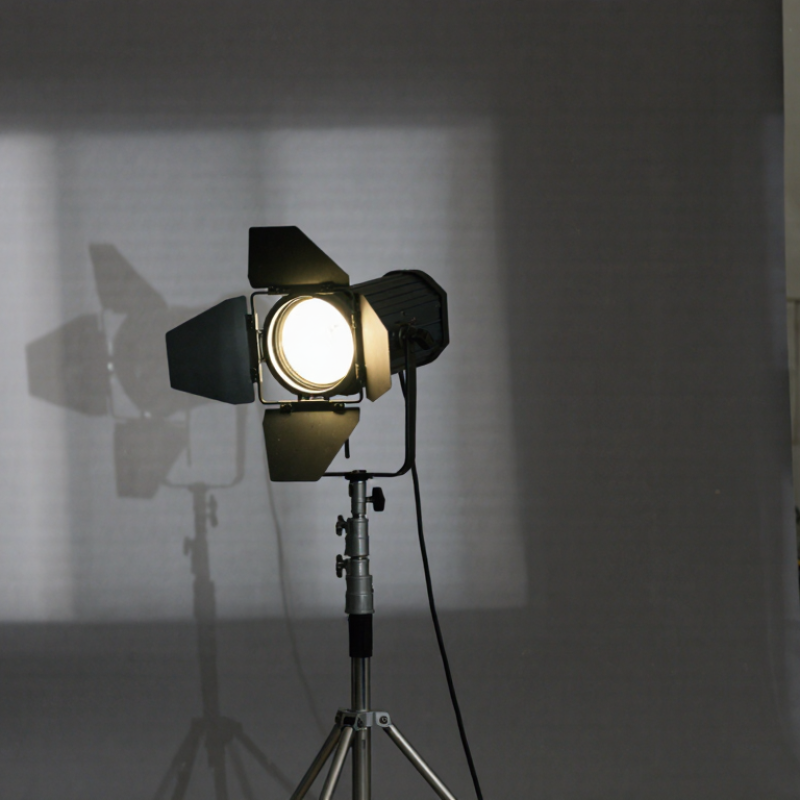
A Fresnel studio light uses a ridged lens to focus and spread light efficiently. Moving the lens changes the beam from broad flood to tighter spot. This optical control creates a defined pool of illumination, but it does not fully prevent spill. Light can still reach a backdrop, lens flare, or a subject’s eyes.
Barndoors provide practical beam control around the Fresnel lens. Each metal flap blocks part of the output, allowing the operator to trim light from walls, floors, or unwanted facial areas. Small adjustments matter. A few degrees can protect a dark background from a bright edge. They also help shape a narrow highlight across a product or actor.
In real studio work, I often adjust one door at a time while watching the shadow line. The result is rarely perfect immediately. Barndoors are not precision shutters, and their edges can create soft, uneven transitions. Flags or cutters may offer cleaner control for demanding setups. Heat is another concern, so the doors should be adjusted carefully and given enough clearance. I have sometimes focused too much on the subject and missed spill behind it. A quick check from the camera position usually reveals that mistake.
| Control Dimension | Typical Fresnel Behavior | Role of Barndoors | Practical Studio Result |
|---|---|---|---|
| Primary optical function | A stepped or molded Fresnel lens concentrates and redirects light into a controllable beam. | Four hinged metal leaves block selected portions of the beam after it exits the lens. | The lens controls beam spread; the leaves control where the beam is allowed to fall. |
| Beam-angle adjustment | Moving the lamp or LED source relative to the lens changes the beam from narrower spot to wider flood. Many studio Fresnels provide an approximate 15°–60° adjustment range, depending on fixture design. | Barndoors do not normally change the optical beam angle evenly. They crop or mask part of the existing beam. | Use the focus mechanism for broad spot/flood changes and the barndoors for localized trimming. |
| Spot position | The source is positioned closer to the lens, producing a narrower, more concentrated beam with higher central intensity. | Leaves can remove spill from the sides or top of the concentrated beam. | Useful for lighting a face, prop, or architectural detail while limiting light on nearby areas. |
| Flood position | The source is positioned farther from the lens, producing a wider beam with more even coverage across a larger area. | Leaves can reduce the usable width or height of the wider beam. | Helps keep a broad wash from reaching walls, curtains, lenses, or unwanted background areas. |
| Edge control | The Fresnel lens creates a relatively smooth beam transition rather than a perfectly sharp projected image. | Leaves create a controllable cutoff, although the edge may remain soft because the Fresnel beam itself is not a hard-image projection. | Produces a visually clean light boundary for interviews, portraits, stage areas, and set lighting. |
| Spill reduction | Without additional masking, light can spread beyond the intended subject or background area. | Barndoors absorb or redirect unwanted rays before they illuminate adjacent surfaces. | Improves contrast and helps reduce flare, background contamination, and unwanted highlights. |
| Four-leaf coverage | The Fresnel lens determines the overall circular or near-circular beam footprint. | Two vertical and two horizontal leaves allow independent control of the beam’s top, bottom, left, and right edges. | The operator can create a rectangle, narrow strip, doorway-like opening, or partial side cut. |
| Light-shaping precision | Optical focusing changes the size and intensity distribution of the entire beam. | Each leaf can be adjusted separately for fast, visual framing of the beam. | Provides faster practical control than repositioning the fixture repeatedly. |
| Shadow behavior | A Fresnel source generally produces defined but not perfectly sharp shadows; shadow softness depends on source size, distance, and focus. | Barndoors mainly alter the illuminated area and do not replace a dedicated gobo or profile projector for detailed shadow patterns. | Good for cutting spill, but not for projecting crisp logos, text, or complex shapes. |
| Intensity trade-off | Spot focus usually increases central illuminance compared with flood focus because the light is concentrated into a smaller area. | Closing a leaf blocks part of the output, so the lit area becomes smaller and total delivered light to the scene may decrease. | After significant cropping, exposure or fixture position may need adjustment. |
| Typical applications | Key light, backlight, sunlight simulation, stage wash, product lighting, and controlled background illumination. | Preventing light from reaching the camera, background, set edges, reflective surfaces, or neighboring subjects. | Combines adjustable beam size with fast spill control in one fixture. |
| Important limitation | Beam performance varies with lens diameter, source type, optical design, focus position, and fixture distance. | Barndoors are not a substitute for flags, cutters, scrims, or projection accessories when extremely precise control is required. | Choose the control tool according to whether the goal is beam-size adjustment, spill blocking, diffusion, or image projection. |
Note: Beam-angle figures are representative ranges for studio Fresnel fixtures rather than a universal specification. Actual output, cutoff sharpness, and intensity depend on the fixture, lens, light source, mounting distance, and focus position.
Many Fresnel fixtures offer approximately 15° to 60° beam adjustment. At 15°, the beam is narrow and concentrated. At 60°, coverage becomes broader.
A 15° beam creates stronger highlights and reaches farther across a set. It suits a face, doorway, or small background area. Watch the edges.
A 60° beam spreads light across a wider interview area or background. Its edges may look softer or uneven. Careful trimming becomes important.
No. The lens and lamp position control spot-to-flood movement. Barndoors shape the chosen beam and block unwanted spill.
Close each leaf until light stops touching the wall or background edge. Keep the leaves near the fixture, but never touch its hot housing. Check shadows.
They can block bright light entering the camera lens from outside the frame. Adjust an upper or side leaf carefully. A separate flag may still work better.
Unwanted light can change wall exposure or create reflections on glossy props. Dark surfaces may reveal contamination quickly. A slow camera pan helps find it.
No. Doubling the distance reduces illuminance to roughly one-quarter. Distance changes intensity, not precise spill direction. I sometimes expect too much from distance.
Use a handheld meter, waveform monitor, and direct visual inspection. Check the background edge slowly. Eyes alone can miss weak reflections.
Understanding why are barndoors used on fresnel studio lights begins with the relationship between Fresnel optics and controlled beam shaping. A Fresnel lens focuses and concentrates light while allowing the beam to move from a narrower spot to a wider flood, commonly across angles of about 15° to 60°. Barndoors add mechanical precision to this process. Two-, four-, and eight-leaf designs can be adjusted to block selected areas of the beam, creating cleaner edges and directing illumination exactly where it is needed.
By limiting spill light, barndoors help prevent unwanted lens flare, background contamination, and illumination of areas outside the composition. They are especially useful for separating a subject from the background or maintaining contrast in a carefully arranged scene. However, beam control does not eliminate the effect of distance: under the inverse-square law, doubling the distance from the light reduces illuminance to approximately 25% of its original level. Therefore, effective Fresnel lighting combines lens adjustment, barndoor positioning, and thoughtful light placement.

 Alterra Lighting