When exploring lighting options for video production, one question frequently arises: what is the difference between COB LED and panel video lights? Both lighting types serve distinct purposes and offer unique advantages. Understanding these differences can greatly impact the quality of your projects.
COB (Chip on Board) LED lights provide a compact and intensely focused light source. These lights excel in producing bright, even illumination. On the other hand, panel video lights offer a broader light spread. They typically come with adjustable color temperatures, making them versatile for various shooting situations.
While COB LEDs are known for their efficiency, panel lights often have user-friendly features. Yet, they may lack the intensity needed for certain setups. As professional videographers and photographers, it’s essential to weigh these characteristics. Reflecting on your specific needs can lead to a better-informed choice. Whether you need precision or versatility, understanding the differences will guide your decision.
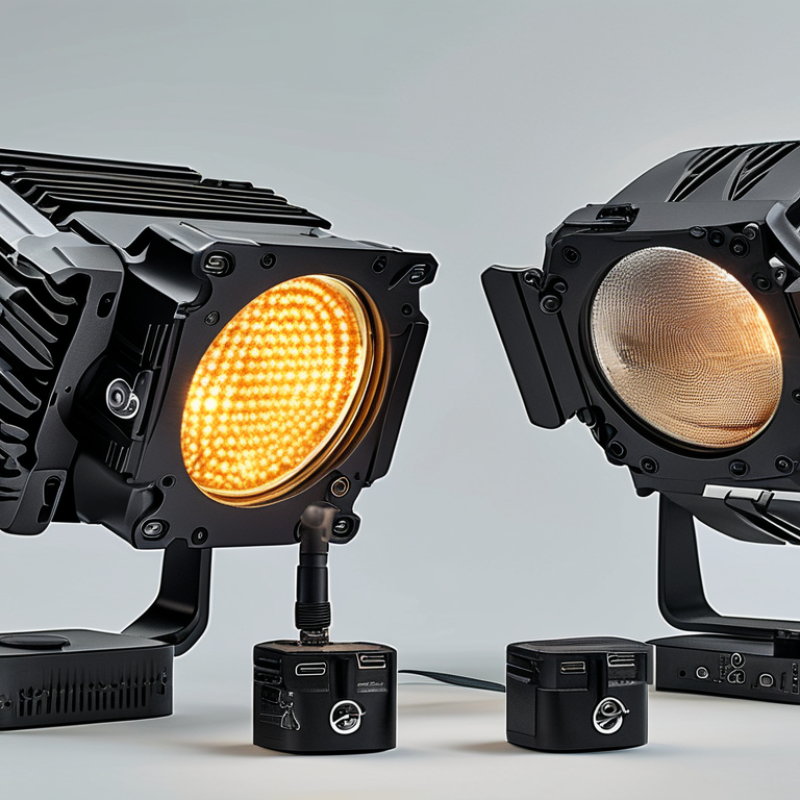
COB (Chip on Board) LED technology revolutionizes lighting efficiency and quality. Unlike traditional panel lights, COB LEDs feature multiple diodes bonded directly onto a substrate. This structure allows for a denser light output with reduced heat generation, resulting in better energy efficiency. Studies suggest that COB LEDs can produce up to 90 lumens per watt, which is significantly higher than panel lights, often producing around 70-80 lumens per watt. The result is brighter, more consistent lighting with improved color rendering.
Panel lights often rely on diffusing materials to soften light, which can sometimes lead to hotspots or uneven illumination. While they are versatile for general lighting, their performance can fluctuate with different setups. Direct installation of COB technology, however, minimizes these issues by providing uniform light distribution. A 2022 industry report highlighted that over 60% of professional videographers prefer COB lights for critical projects due to their superior output and reliability.
Despite these advantages, choosing lighting technology often involves trade-offs. COB lights may have higher upfront costs. Also, their physical size can be limiting for compact setups. Panel lights, being lighter and thinner, can fit more environments. Evaluating needs, and understanding light technologies' limitations, is essential for optimal results.
| Feature | COB LED Lights | Panel Video Lights |
|---|---|---|
| Light Source Technology | Chips on Board (COB) | Multiple LED Bulbs |
| Light Quality | High Color Rendering Index (CRI) | Variable CRI Based on Design |
| Heat Management | Better Heat Dissipation | Less Efficient Heat Management |
| Size and Weight | Generally Smaller and Lighter | Larger and Heavier |
| Light Output | Higher Lumen Output | Lower Lumen Output |
| Beam Angle | Wide Beam Angle Options | Varied Beam Angles |
| Durability | More Durable | Less Durable |
| Cost Efficiency | Higher Initial Cost, Lower Long-term | Lower Initial Cost, Higher Long-term |
| Ease of Use | User-Friendly Controls | More Complicated Interfaces |
| Power Consumption | Lower Power Consumption | Higher Power Consumption |
: COB LED technology bonds multiple diodes onto a substrate, allowing dense light output and reduced heat generation.
COB LEDs produce about 90 lumens per watt, while panel lights usually offer 70-80 lumens per watt.
Panel lights are lightweight and versatile, making them suitable for various environments and setups.
COB LED lights are typically more affordable upfront compared to panel lights, but may have higher long-term costs.
Over 60% of professional videographers prefer COB lights for their superior output and reliability.
Uniform light distribution prevents hotspots and ensures consistent illumination, which is ideal for photography and videography.
Cheaper lights may require frequent replacements, leading to higher costs over time.
Assess your needs, budget, and the specific performance of each option to make an informed choice.
Yes, panel lights use diffusing materials to create soft, even lighting, but performance can vary.
COB lights can have higher upfront costs and may not fit in compact setups due to their size.
When exploring "what is the difference between COB LED and panel video lights," it's essential to consider various factors that affect their performance and suitability for different applications. COB LED lights utilize a chip-on-board technology that allows for a more concentrated light source, resulting in higher brightness and better color rendering, while panel video lights often provide a softer, more diffused light ideal for evenly lighting a larger area.
The size and portability of these lights also vary, with COB LEDs generally being more compact and easier to transport, making them suitable for on-the-go shoots. In contrast, panel lights, while potentially bulkier, offer versatility in terms of lighting options. Additionally, the cost analysis indicates that while COB LED lights may have a higher initial investment, they can be more efficient in long-term usage. Ultimately, understanding these differences helps set the right expectations for filmmakers and content creators choosing between these two lighting technologies.

 Alterra Lighting