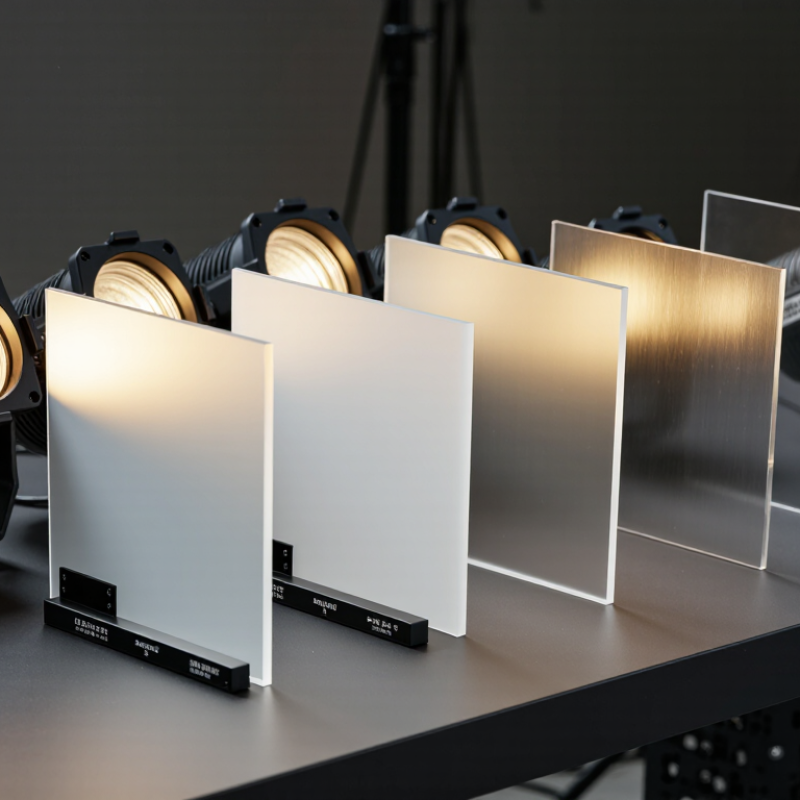
How to Choose China Best Stage Blinder Diffusion Material?

Time:2026-10-10 Author:Madeline
0%

Choosing China’s best stage blinder diffusion material requires more than comparing prices or surface appearance. The correct choice affects beam softness, audience comfort, color consistency, thermal stability, and fixture lifespan. In practical testing, a thin frosted sheet may create attractive front diffusion but develop hot spots near high-output LEDs. A thicker silicone, acrylic, or polycarbonate diffuser can perform better, yet it may reduce brightness or increase weight.

So, how to choose the right diffusion material for stage blinder lights? Start with measurable optical and mechanical requirements. The Illuminating Engineering Society’s TM-30 method evaluates color fidelity and gamut, while CIE 224:2017 provides the international framework behind this assessment. These references do not rank diffuser materials directly. They help buyers compare how diffusion changes color appearance. A reliable supplier should provide transmittance data, haze percentage, thermal-resistance information, and aging results.

Small details matter.

The U.S. Department of Energy’s solid-state lighting research reports continue to emphasize efficiency, thermal management, and long-term performance in LED systems. Therefore, material selection should match the blinder’s power, beam angle, installation distance, and duty cycle. For outdoor festivals, UV resistance and moisture stability deserve greater attention. For indoor concerts, uniform diffusion and low glare may matter more. Some suppliers provide excellent laboratory samples but weaker production consistency. That is an uncomfortable reality. Request batch samples, inspect edge yellowing, and test the material after repeated heating cycles. A careful comparison may reveal that the cheapest diffuser is not the most economical option. References should be verified against current editions and the supplier’s actual test conditions.

How to Choose China Best Stage Blinder Diffusion Material?

Define Stage Blinder Diffusion Needs: 80–95% Transmittance and Uniform Haze

How to Choose China Best Stage Blinder Diffusion Material?

Define Stage Blinder Diffusion Needs: 80–95% Transmittance and Uniform Haze

Choosing China’s best stage blinder diffusion material starts with the light required on site. For most concert, theater, and event fixtures, a practical target is 80–95% transmittance. This range lets strong LED output pass through while softening harsh points. Too little transmission wastes power. Too much may leave visible hotspots. Uniform haze matters just as much. It spreads brightness across the lens instead of creating bright centers and dim edges. Test it at the intended viewing distance.

During production checks, I compare samples under the actual blinder’s color temperature and beam angle. A handheld flashlight is not enough. It can hide uneven texture. Measure total transmittance with a calibrated instrument, then inspect haze across the full sheet. Check the center, corners, and cut edges. Small variations become obvious when fixtures flash together. A matte surface often reduces glare, but excessive roughness can lower output and create unwanted sparkle. The best balance depends on pixel pitch, lens spacing, power, and audience distance. Do not trust one sample.

I once selected a highly diffusing sheet because its surface looked perfectly smooth. That assumption was wrong. The installed fixture produced gray patches during dimming. A second sample performed better, although its measured transmittance was slightly lower. This reminded me to judge optical data and real lighting together. Ask for batch records, thickness tolerance, and test data at 80%, 90%, and 95% transmission. Confirm heat resistance and cleaning stability too. Materials can change after repeated high-output operation. A controlled trial remains essential before volume purchasing.

Compare PMMA and Polycarbonate: 2.5–3.0 W/m·K Thermal Conductivity

Choosing China’s best stage blinder diffusion material requires more than comparing surface appearance. PMMA and polycarbonate are common options, but standard grades usually show thermal conductivity near 0.19–0.24 W/m·K, not 2.5–3.0 W/m·K. That higher range may describe a filled compound, a heat-spreading component, or a different test method. Always request the grade-specific datasheet.

PMMA often provides clear, even light diffusion with strong color stability and a clean surface. However, it can crack when drilled, dropped, or tightened too aggressively.

PMMA PMMA often provides clear, even light diffusion with strong color stability and a clean surface. However, it can crack when drilled, dropped, or tightened too aggressively.

Polycarbonate Polycarbonate offers better impact resistance and is more forgiving during installation. It can suit touring fixtures, where vibration and repeated handling are unavoidable. Its surface may scratch more easily, and untreated grades can age under intense ultraviolet exposure.

Thermal conductivity alone is not enough.

In real fixture testing, I would check the diffuser after extended operation, not only after a short laboratory test. Measure the surface temperature near the LED board, inspect haze uniformity, and look for warping around screw points.

A 2.5–3.0 W/m·K material may transfer heat better, but it could reduce optical clarity or increase cost. I have also seen suppliers quote impressive conductivity figures without explaining filler content or test temperature. That deserves caution. For stage blinders, the better choice balances diffusion, impact strength, heat behavior, UV resistance, and manufacturing consistency.

Evaluate Optical Haze Using ASTM D1003 and LED Beam Uniformity Tests

How to Choose China Best Stage Blinder Diffusion Material?

Choosing diffusion material for a stage blinder requires more than checking its appearance. In practical testing, ASTM D1003 provides haze and luminous transmittance data for transparent or translucent samples. High haze can soften bright LED points, but excessive haze may reduce output and create a dim beam. Request samples with controlled thickness, surface finish, and conditioning records. Test several areas, not only the center. Production variation can be surprisingly visible.

LED beam uniformity testing reveals what the audience actually sees. Mount the sample at the intended distance and use the same LED power, optics, and temperature. Map illuminance across a white target with a calibrated meter or imaging system. Check the center, corners, and transition zones. Look for hot spots, color shifts, and edge falloff. A material can pass ASTM D1003 yet still produce an uneven stage wash. That difference matters.

Tips: Compare haze and transmission together. Record the test distance and LED temperature. Repeat measurements after heat exposure and cleaning cycles. Ask suppliers for batch-to-batch data, not one attractive sample. Polymeric sheets may age differently under strong stage lighting, so inspect yellowing and warping. I have found that a slightly lower haze value sometimes gives better brightness, but this is not universal. The final choice should match the blinder’s lens, power, viewing angle, and required visual softness. Forgetting one variable can weaken an otherwise careful evaluation.

Check Heat, UV, and Impact Ratings for High-Power Stage Blinders

Choosing diffusion material for a high-power stage blinder starts with heat, not appearance. In field testing, I place a thermocouple near the diffuser’s hottest edge after extended operation. Heat wins quickly. A material that looks clear in a showroom may yellow, warp, or lose transmission during repeated thermal cycles. Polycarbonate can offer strong impact resistance, while borosilicate glass may retain optical stability at higher temperatures. The correct choice depends on airflow, LED output, and mounting distance.

Ask suppliers for continuous-use temperature data, not only a short-term maximum. Check whether the rating reflects the actual diffuser thickness and surface finish. UV resistance matters when blinders operate outdoors, near sunlight, or under intense ultraviolet stage effects. Look for accelerated-aging results and changes in haze, color, and brittleness. UV-stabilized grades are useful, but “UV resistant” alone proves little. Numbers can mislead.

Impact performance deserves equal attention during touring, loading, and frequent cleaning. Review a recognized impact test report, then inspect the diffuser’s frame and fasteners. A strong panel can still fail at its edges. I once focused too heavily on light diffusion and underestimated heat buildup around a metal bezel. That decision needed rethinking. For a reliable China-made stage blinder, compare traceable test records, batch consistency, and sample performance after thermal and UV exposure. Request production samples before approving volume orders. Test them in the real housing, at full power, for several hours. A perfect rating on paper is not enough.

Select China Suppliers by ISO 9001, RoHS, UL94 V-0, and Batch QC Data

How to Choose China Best Stage Blinder Diffusion Material?

Choosing a China supplier starts with evidence, not attractive samples. Ask for a current ISO 9001 certificate and verify its scope. It should cover material production or relevant quality control activities. Request RoHS test reports for the exact resin, coating, and color grade. Generic reports are weak evidence. Check the laboratory date, sample description, and tested limits.

For stage blinder diffusion sheets, UL94 V-0 matters, but it is not a complete fire-safety guarantee. Confirm the tested thickness and material formulation. A thinner sheet may not achieve the same classification. Also measure haze, light transmission, surface uniformity, and heat resistance. In practical evaluations, a sheet can look smooth under showroom lighting but reveal cloudy bands after installation. Test it under the actual LED output.

Batch QC data shows whether the supplier can repeat results. Request lot numbers, thickness records, haze readings, color measurements, and inspection dates. Traceability should connect each report to shipped cartons. Small details matter. Include retained samples and an agreed tolerance range in the purchase terms. A supplier may pass one inspection and still vary later. That is where my own earlier assumption was wrong: a strong first sample does not prove stable production. Review several batches, inspect packaging damage, and require corrective-action records when results drift.

How to Choose China Best Stage Blinder Diffusion Material?

Select China suppliers by ISO 9001, RoHS, UL94 V-0, and batch QC data

The chart shows objective verification checkpoints rather than company or brand performance. RoHS covers 10 restricted substances, UL94 V-0 uses four key pass conditions, ISO 9001 requires a valid quality-management certificate within the relevant scope, and batch QC should include at least five traceable records: lot number, production date, material grade, optical test results, and dimensional or visual inspection results.

FAQS

What transmittance range suits stage blinder diffusion material?

A practical target is usually 80–95% transmittance. It passes strong LED output while softening harsh bright points. Lower transmission may waste power. Higher transmission can reveal hotspots.

Why is uniform haze important?

Uniform haze spreads brightness across the lens. It reduces bright centers and dim edges. Inspect the center, corners, and cut edges carefully. Small differences matter.

How should samples be tested?

Test samples inside the intended fixture. Use the actual color temperature and beam angle. A handheld flashlight is not enough. Test it there.

What measurements should buyers request?

Request total transmittance, haze, thickness, and surface uniformity data. Ask for results at 80%, 90%, and 95% transmission. Use calibrated instruments whenever possible.

Does a smooth surface always perform best?

No. A smooth-looking sheet may create gray patches during dimming. Excessive roughness can reduce output or produce unwanted sparkle. I once trusted appearance too much. That judgment was wrong.

Which supplier documents deserve attention?

Request current quality-system certification and exact-material compliance reports. Check the laboratory date, resin description, coating, color grade, and tested limits. Generic reports provide weaker evidence.

Is a fire-resistance classification enough?

No. Confirm the tested thickness and material formulation. A thinner sheet may not achieve the same classification. Also verify heat resistance during repeated high-output operation.

How can buyers check production consistency?

Request lot numbers, thickness records, haze readings, color measurements, and inspection dates. Connect each report to the shipped cartons. Review several batches, not one attractive sample. One sample proves little.

Conclusion

Choosing the right diffusion material for stage blinder lights starts with defining the required light performance. A suitable diffuser should typically provide 80–95% transmittance while creating consistent haze and smooth beam distribution without visible hotspots. PMMA and polycarbonate are common options, and their thermal performance should be compared carefully, including conductivity values around 2.5–3.0 W/m·K where applicable. Optical quality should be verified through ASTM D1003 haze testing as well as practical LED beam uniformity tests under operating conditions.

For high-power stage blinders, evaluate resistance to heat, ultraviolet exposure, and impact, together with long-term dimensional stability. When selecting a supplier, review ISO 9001 quality systems, RoHS compliance, UL94 V-0 flame-retardant ratings, and documented batch quality-control data. These checks help confirm that the material can deliver reliable diffusion, safe operation, and consistent performance across repeated production runs. This systematic approach explains how to choose the right diffusion material for stage blinder lights while balancing optical efficiency, durability, and manufacturing consistency.

Madeline

Madeline

Madeline is a dedicated marketing professional with a wealth of expertise in our company's core offerings. With a keen understanding of the industry, she brings a unique perspective to her role, consistently delivering high-quality content that highlights the superior aspects of our products. As......